Politics
How Saraki’s Defection To APC Pushed Me Out Of Jonathan’s Govt – Bolaji Abdullahi

A former Minister of Youth Development and Sports, Bolaji Abdullahi, has revealed that he was appointed into the Federal Executive Council by ex-President Goodluck Jonathan without any prior personal relationship.
Abdullahi made the disclosure in his memoir, The Loyalist, scheduled for public presentation on Tuesday.
Story continues below advertisement
The 297-page book chronicles his two-decade journey through Nigerian politics, offering insights into governance at both state and federal levels, as well as the personal costs of political loyalty.
According to Abdullahi, his appointment came shortly after he completed his tenure as Commissioner for Education in Kwara State.
He said he was one of eight names forwarded to President Jonathan for ministerial consideration from the state, stressing that he had no personal relationship with the president before the appointment.
Story continues below advertisement
He acknowledged, however, that his close political association with the leadership in Kwara State played a role in securing the nomination.
Abdullahi served under former Kwara State Governor Bukola Saraki, first as a special assistant from 2003 and later as commissioner from 2007. Saraki had just completed his second term as governor and was succeeded by Abdulfatah Ahmed, another of his former commissioners.
Abdullahi said his appointment, largely made to fulfil constitutional requirements, plunged him into a politically tense environment.
Story continues below advertisement
“For most of my time as minister, I felt like a man on death row who did not know when his executioner would come,” he wrote.
He recalled being listed among ministers expected to be dismissed on September 11, 2013. Although he survived that purge, he was eventually removed from office on March 5, 2014.
According to him, the political climate at the time made his exit almost inevitable.
Story continues below advertisement
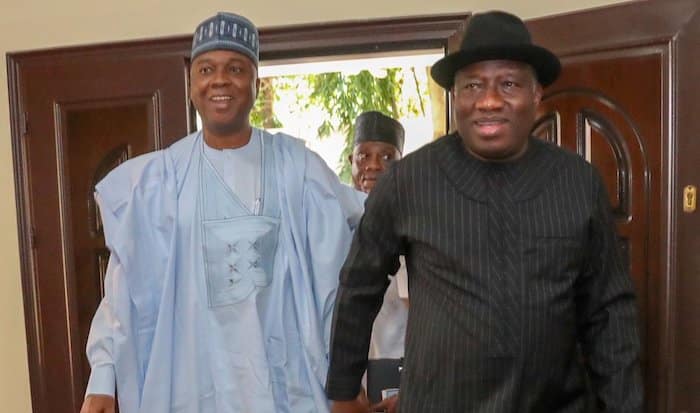
Abdullahi linked his dismissal to the political battle between Jonathan and Saraki, who was then a senator.
Saraki had defected from the Peoples Democratic Party to the newly formed All Progressives Congress alongside 11 other senators and five governors, a move widely seen as a major blow to Jonathan’s re-election bid.
As a known loyalist of Saraki serving in Jonathan’s cabinet, Abdullahi said he became a subject of suspicion.
Story continues below advertisement
“Even my colleagues could not hide their suspicion,” he wrote.
Abdullahi said he anticipated his dismissal early and prepared himself accordingly.
“Since my appointment, I had organised myself in such a way that I would not require much time to move out,” he wrote.
Story continues below advertisement
“I never planned for anything beyond a four-month cycle.”
He added that he prepared his family and aides for the possibility of sudden exit, noting that ministerial appointments are held at the absolute discretion of the president.
The former minister said he initially saw himself as a technocrat rather than a politician, a view Saraki also encouraged when he was appointed in 2011.
Story continues below advertisement
“Partisan politics did not interest me,” he wrote, adding that he preferred to focus on his job.
However, Abdullahi said he later realised that ministerial positions are inherently political, especially as elections approach.
Abdullahi said Saraki’s defection forced him into a moral dilemma: renounce his political mentor to prove loyalty to Jonathan or stand by Saraki and risk losing his job.
“At that point, only a total disavowal of Saraki could have saved me,” he wrote.
“But that would have also meant renouncing the very principles my father had taught me were more important than all the riches in the world.”
He described himself as “the grass suffering while two elephants fought.”
Abdullahi said he avoided discussing Saraki’s defection directly with Jonathan, fearing it could force him into taking sides or be misconstrued as political manoeuvring.
He noted that Jonathan appeared to dislike treachery, even when committed in his favour.
Abdullahi said: “I never did because I was afraid he might misconstrue my motive, and I would have ended up waving a red flag at an otherwise friendly bull.”
“Another reason I did not bring up the Saraki issue with him was that I feared it might lead to a situation requiring me to take sides. More importantly, in a bid to prove my loyalty to him, I might have inadvertently given the impression that I was willing to take sides with him. In my interactions with him, I made deliberate efforts to understand his worldview, and he came across to me as a man who disliked treacherous people, even if their treachery was in his service.”
“With Senator Saraki, however, it was not so difficult to bring up the matter. In fact, I thought it would be expected of me to do so. A couple of times, I asked him what the real problem was with the president, and he explained what he thought it was. I was, however, careful not to tell him how his relationship with Jonathan was reflecting on me and how I was suffering as a result. I knew he could be very suspicious and even distrustful,” the author said.