Politics
Who Saved Nigeria In 2010? Mark, Abdullahi Disagree Over Origin Of ‘Doctrine Of Necessity’


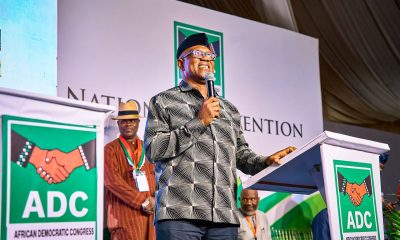
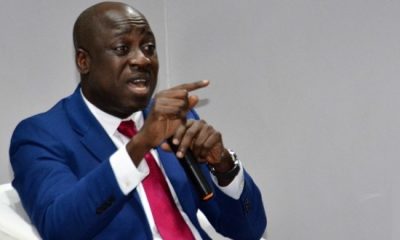
Former Senate President, David Mark, and former Minister of Youth Development and Sports, Bolaji Abdullahi, on Tuesday offered conflicting accounts over the origin of the Doctrine of Necessity that paved the way for the emergence of Goodluck Jonathan as Acting President during the prolonged illness of late President Umaru Musa Yar’Adua.
Mark, now National Chairman of the African Democratic Congress (ADC), insisted that the initiative was entirely that of the Senate and had nothing to do with the Nigeria Governors’ Forum led at the time by former Kwara State Governor, Bukola Saraki.
Story continues below advertisement
He made the assertion in Abuja during the public presentation of Abdullahi’s memoir, The Loyalist.
In the 297-page book, Abdullahi claimed that the idea of invoking the Doctrine of Necessity originated from the Nigeria Governors’ Forum under Saraki and was later adopted by the National Assembly.
“I actually heard about the term ‘Doctrine of Necessity’ for the first time when Governor Saraki called from Abuja asking me to draft a statement to propose it to the National Assembly,” Abdullahi wrote.
Story continues below advertisement
He explained that the proposal emerged at a time of deep political uncertainty, following President Yar’Adua’s prolonged absence from the country due to ill health without transmitting the required written declaration under Section 145 of the Constitution.
Abdullahi further recounted tensions between Saraki and Jonathan during the Yar’Adua administration, describing Saraki as the powerful chairman of the Nigeria Governors’ Forum who enjoyed a close relationship with the president.
“Jonathan, on the other hand, was the largely neglected vice president who lurked in the shadows,” he wrote, adding that it was easy for Jonathan to feel sidelined.
Story continues below advertisement
According to him, suspicions lingered in Jonathan’s circle after Yar’Adua’s death that Saraki and some governors had frustrated Jonathan’s formal takeover as acting president.
He, however, dismissed that view as incorrect.
“In reality, it was Saraki’s NGF that proposed the Doctrine of Necessity, which was adopted by the National Assembly to pave the way for Jonathan’s formal ascendance as acting president,” Abdullahi stated.
Story continues below advertisement
Responding, Mark firmly rejected Abdullahi’s claim, stressing that the doctrine was conceived and executed solely by the Senate.
“The Doctrine of Necessity is the sole responsibility of the Senate and has nothing to do with Kwara State or anyone from Kwara State. It was the sole responsibility of the Senators of that time,” Mark said.
He explained that the decision was taken collectively by lawmakers in the interest of national stability at a time when the country faced a constitutional crisis.
Story continues below advertisement
Despite disagreeing with Abdullahi’s account, Mark commended Saraki’s patriotism and commitment to Nigeria.
“Mission to rescue Nigeria is collective. He is a straightforward person, and even when I disagreed with him, his advice was always adopted. He is a committed Nigerian, very patriotic,” Mark said.
On February 9, 2010, after weeks of uncertainty, the Senate invoked the Doctrine of Necessity to swear in then Vice President Jonathan as Acting President, vesting him with full presidential powers pending Yar’Adua’s recovery.
Story continues below advertisement
This action was taken to address a leadership vacuum caused by the prolonged absence of then-President Umaru Yar’Adua, who had been receiving medical treatment in Saudi Arabia since November 23, 2009, without formally transmitting power to his deputy.
The decision is widely regarded as one of the most consequential constitutional interventions in Nigeria’s democratic history.