Politics
Dislodging Tinubu, APC Won’t Be Easy — Moghalu


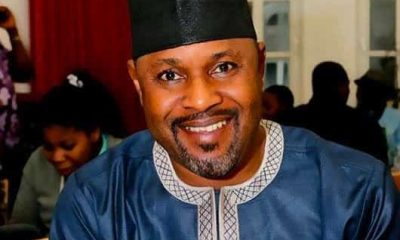
A former All Progressives Congress (APC) stalwart and Labour Party (LP) governorship candidate in the recent Anambra election, George Moghalu, has warned that removing President Bola Ahmed Tinubu and the ruling APC from power will be a tough task.
Speaking to journalists in Abuja on Wednesday, Moghalu said opposition political parties currently lack the cohesion necessary to mount a credible challenge to an incumbent government, stressing that fragmentation will likely spell failure for any campaign against the APC.
He said, “Let me repeat what I have consistently said: removing an incumbent is not a tea party. The only way you can remove an incumbent or present a credible and formidable opposition is when there is unity of purpose among opposition political parties and leaders.”
The former National Auditor of the APC recalled how the ruling party itself was formed through a merger of several opposition parties ahead of the 2015 elections, allowing it to end the long dominance of the Peoples Democratic Party (PDP).
Before the APC’s formation, he noted, opposition parties such as the ANPP, CPC, and ACN operated independently and consistently failed to unseat the PDP despite strong candidates.
“We presented Buhari in 2003 and 2007, and he lost. He ran again in 2011 on the platform of CPC and lost because the opposition was fragmented. Each party had its own support base, and the PDP had the advantage,” Moghalu said.
Moghalu explained that it was only after the amalgamation of forces, including the ACN, CPC, ANPP, a faction of APGA and the DPN, that the APC emerged as a formidable platform.
“It was not just a merger or an alliance. It was a case of everyone dropping personal ambition and ego. That was what produced the APC and eventually defeated the PDP,” he said.
He argued that the same political reality still applies today and warned that as long as opposition parties remain divided, the APC will continue to dominate the political landscape.
“A strong opposition ultimately benefits the people rather than politicians,” he said.
On internal party leadership struggles, particularly arising from defections by sitting governors, Moghalu said the influence of incumbency often overrides merit in Nigerian politics.
“They are not party leaders because they are the most qualified or educated, but because power revolves around them. They have resources, influence and leverage, and that is the reality of our politics,” he said.
He explained that this hierarchy flows from the President at the national level to governors in the states and local government chairmen at the grassroots.
Moghalu dismissed fears that Nigeria might become a one‑party state, noting that political dominance is often temporary.
“We have seen this before. The PDP once controlled about 29 states, and today it has about six. Politics is dynamic. Nobody can accurately predict the future of the APC,” he said.
Defections: Ambition Over National Interest
Speaking on his own political future, Moghalu said he is still consulting with supporters on whether to remain in the LP, defect to the African Democratic Congress (ADC), or return to the APC.
He described political parties as interest‑driven platforms rather than ideological institutions, adding that defections are often motivated by personal ambition rather than national interest.
On the controversy surrounding defections by elected officials, Moghalu said such actions are morally questionable if the office holder refuses to relinquish the mandate obtained under one party.
“The ballot paper bears the name of the party, not the candidate. Morally, it is not justifiable to take the people’s mandate to another party without their consent,” he stated.
He added that the best way to test the sincerity of defectors is for them to resign their positions before switching parties.
Asked about claims that the APC’s performance is driving defections, Moghalu maintained that political alignment in Nigeria is largely transactional and interest‑based rather than performance‑driven.